


In the modern era of software development, data flexibility and scalability are paramount. MongoDB, as the leading NoSQL document database, has become a cornerstone technology for countless enterprises and startups alike. As adoption grows, so does the demand for professionals validated in its specific skillset.
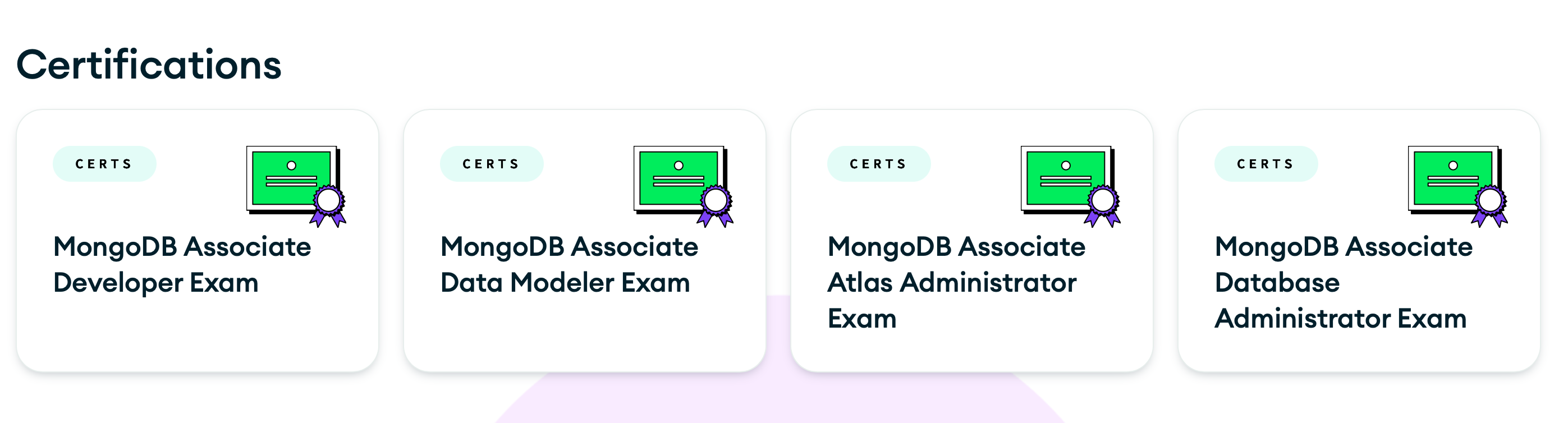
MongoDB certifications are the official recognition of your expertise. To better reflect the distinct roles required in today’s ecosystem—especially with the dominance of cloud-managed services—MongoDB currently offers four distinct “Associate” level certification pathways.
Here is a detailed breakdown of these four pathways, their objectives, and the roadmap to achieving them.
1. The MongoDB Associate Developer Exam
This certification is designed for software engineers who build applications that interact with MongoDB. It focuses squarely on the “client-side” of the database: how to store data efficiently, how to retrieve it using complex queries, and how to optimize application performance code-side.
Target Audience
Backend Software Developers (Node.js, Python, Java, C#, etc.)
Full-Stack Engineers
Key Exam Objectives
The Developer exam tests your ability to translate application requirements into database operations.
CRUD Operations: Deep knowledge of creating, reading, updating, and deleting documents using the MongoDB Query Language (MQL).
The Aggregation Framework: Often the most challenging part. You must understand how to build complex data processing pipelines for analytics within the database.
Indexing and Performance: Knowing not just how to create an index, but which index to create to support specific query patterns and avoid bottlenecks.
Drivers: How applications connect to MongoDB, handle connection pooling, and manage transactions.
The Developer Roadmap
Foundational Knowledge: Start with a strong grasp of your preferred programming language.
MongoDB University: Complete the developer learning path, focusing heavily on Aggregation Framework courses.
Hands-on Building: Build a real application. Force yourself to use complex aggregations instead of processing data in your application code.
Practice Exams: Use official practice tests to get used to analyzing code snippets to predict outputs.
2. The MongoDB Associate Database Administrator (DBA) Exam
While cloud services are popular, many organizations still run self-managed MongoDB infrastructure on-premise or in their own cloud environments (like AWS EC2). This certification focuses on the deep internals required to manage, secure, and troubleshoot these self-managed deployments.
Target Audience
System Administrators
Traditional DBAs transitioning to NoSQL
Site Reliability Engineers (SREs) managing infrastructure
Key Exam Objectives
The DBA exam focuses on keeping the database health, secure, and available “under the hood.”
Deployment & Ops: Configuring replica sets for high availability and understanding election processes.
Performance Diagnostics: Analyzing server logs, using profiling tools, and understanding the WiredTiger storage engine to diagnose slow performance.
Sharding Mechanics: The technical implementation of sharding for horizontal scaling, including choosing shard keys and balancing chunks.
Self-Managed Security: Implementing OS-level security, authentication mechanisms (SCRAM, x.509), and encryption at rest without reliance on cloud UI tools.
Backup and Recovery: Manual strategies for point-in-time recovery, snapshots, and disaster recovery planning.
The DBA Roadmap
System Foundations: Ensure strong Linux command-line and networking knowledge.
Infrastructure Labs: Set up a local MongoDB Replica Set using Docker or VMs. Break it on purpose (kill a primary node) and observe the failover.
Focus on Diagnostics: Practice using command-line tools like
mongostatandmongotopto identify system stress.
3. The MongoDB Associate Atlas Administrator Exam
This is the newest and increasingly most relevant pathway. It focuses specifically on MongoDB Atlas, the fully managed global cloud database service. This role is less about managing servers and more about configuring the cloud platform effectively.
Target Audience
Cloud Engineers / DevOps Engineers
Modern DBAs working primarily in the cloud
Technical Leads managing cloud infrastructure
Key Exam Objectives
This exam tests your ability to utilize the Atlas platform features.
Cluster Management: deploying, scaling, and modifying Atlas clusters across different cloud providers (AWS, Azure, GCP).
Atlas Security: Managing IP Access Lists, VPC Peering, Private Links, and Database User roles within the Atlas UI.
Monitoring and Alerting: Using the Atlas metrics dashboard, setting up real-time alerts, and using the Performance Advisor to identify slow queries.
Atlas Features: Understanding integrated services like Atlas Search, App Services (formerly Realm), and Online Archive.
Backup Strategies: Configuring automated backup policies and performing restores using the Atlas interface.
The Atlas Admin Roadmap
Cloud Fundamentals: Basic understanding of cloud concepts (regions, VPCs, IAM).
Hands-on Atlas: Create a free-tier Atlas account. Explore every menu. Set up network peering (even if just hypothetically).
Performance Advisor: Intentionally run slow queries against your free tier cluster and see what recommendations the Atlas Performance Advisor provides.
4. The MongoDB Associate Data Modeler Exam
Formerly sometimes referred to as the “Architect” path, this certification is strategic. It is less about typing commands and more about making high-level decisions regarding how data is structured to meet business requirements for performance and scalability.
Target Audience
Senior Software Engineers
Solutions Architects
Data Architects moving from SQL to NoSQL
Key Exam Objectives
The Modeler exam tests your ability to design schemas that scale.
Embedding vs. Referencing: The fundamental choice in document databases. Knowing precisely when to denormalize (duplicate) data for read performance versus normalizing it (linking) for write efficiency.
Schema Design Patterns: Recognizing standard MongoDB patterns (e.g., The Attribute Pattern, The Bucket Pattern, The Polymorphic Pattern) and applying them to real-world scenarios like IoT data or product catalogs.
Data Lifecycle Management: Designing schemas that account for data aging, archiving strategies, and data sovereignty requirements.
The Modeler Roadmap
Contrast Study: Deeply study the CAP theorem and the fundamental shift from relational “schema on write” to document “flexible schema.”
Case Study Analysis: Take hypothetical business scenarios (e.g., “Design a Twitter clone”) and whiteboard the schema. Defend your choices.
Pattern Recognition: Memorize standard schema patterns and their specific pros and cons.
Whichever path you choose, the cornerstone of your preparation should be the official MongoDB University. It provides free training tightly aligned with these exams. Do not rely solely on theory; hands-on experience—whether breaking a local replica set for the DBA track or configuring peering for the Atlas track—is vital for passing these scenario-based exams.